
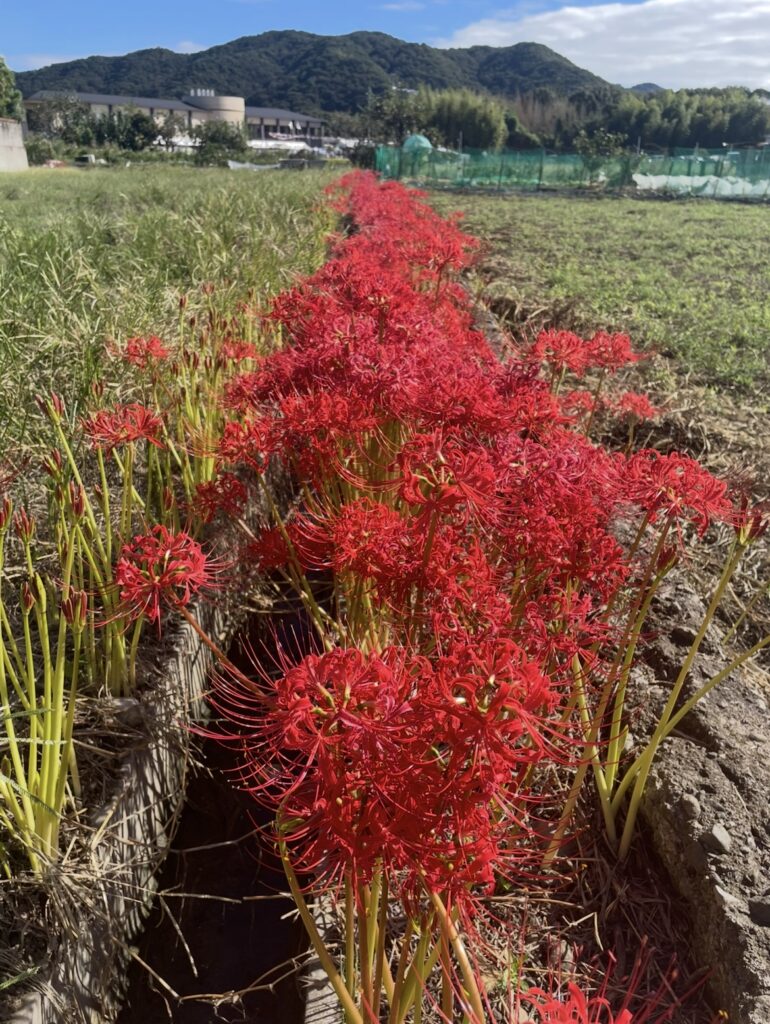
The following extract is taken from my forthcoming book Spider Lily: Six Toxic Tales from Japan, which comprises six darkly themed stories, each centred around a symbolic flower. The book explores themes of sexual discrimination, power harassment, and other social issues.
This particular piece was inspired by the concept of hana kotoba—the language of flowers. For example, red camellias are associated with passion, while the spider lily (the title of one of the other stories in Spider Lily: Six Toxic Tales from Japan and the subject of the attached photo taken last October) is linked to farewells, among other meanings.
“The Language of Flowers” revolves around the female proprietor of a flower shop in feudal-era Kyoto who wishes to teach ikebana but is held back by the patriarchal structure of the time: instruction was passed down the male family line, and flower arrangement, according to my research, was regarded as a male pursuit designed to prepare men for the battlefield.
In addition to these obstacles, the proprietor is gaslit by her assistant, Taro, who tries to convince her that she is losing her mind in her old age.
As will hopefully be apparent upon reading, to those familiar with regional accents around the UK, Taro speaks with a Yorkshire lilt. He frequently drops his articles and employs the glottal stop (something frustratingly difficult to capture in writing). This stylistic choice was intended to convey the roughness of Taro’s Banshū dialect against the old lady’s refined Kyoto style. Perhaps if I’d been born American, Taro would’ve spoken with a Southern drawl, or if Australian, an Aussie twang.
Anyway, that’s all I’ll say for now. Hopefully, the extract will speak for itself and the spider lilies will be in bloom again in just a few weeks.
Thanks for reading.
—Andrew Innes
A flower shop with a thatched roof stood on a dirt road that curved past a dense bamboo grove. It was an old wooden structure with sliding paper doors and a tiled roof, nestled among several other businesses on a quiet street in rural Kyoto. A small river wound through the neighbourhood, and several ducks were now navigating their way around the partially frozen surface of their home.
The wooden walls were adorned with hanging baskets of seasonal flowers: bright pinks and yellows that sparkled in the last of the day’s winter sun. Inside, an old lady was putting the finishing touches on an arrangement commissioned by an extremely important customer. The wind chime by the doorway signalled the arrival of a customer as a shy-looking young lady pushed open the sliding door and started browsing. She wore a faded indigo kimono and kept her eyes low; her cheeks flushed after the chill of Kyoto’s winter streets.
“Hello. Do you need any help, dear?” asked the old lady.
“I’m just looking, thank you.”
The old lady smiled and returned her attention to the arrangement. A few minutes passed, with the young lady occasionally leaning forward to read a label attached to an arrangement or to smell the perfume of something that caught her eye. The air inside the shop had a different quality to it—warm and somehow alive.
“Can I ask a question?”
Most customers got down to business and asked for what they wanted the moment they walked through the door: an arrangement for a funeral or a wedding, or perhaps flowers to say thank you for something. Yet, occasionally, a customer danced around what they really wanted to say, lost for words as the old lady waited patiently for what she knew was coming—matters of the heart.
“Yes, dear. How can I help?”
“There is someone in my village. A man whom I respect and admire.” The young lady turned to inspect a bunch of pink flowers as she spoke. “We have courted a couple of times, and, well, surely that would mean that we are on the path to becoming husband and wife?”
The old lady nodded as the young lady walked around the shop, inspecting the leaves of an exotic plant that towered over a water feature in the corner before stopping to gaze out of the window at the snow that fell outside.
“He acts as though we have all the time in the world to get married, and yet I am already twenty-one! It’s like he’s more interested in fishing with his friends or playing shōgi at all hours. At this rate, I’ll end up an old spinster.” The young lady turned from the window to face the old lady.
“Well, dear, sometimes flowers speak when words fail us.” As the old lady said this, her assistant emerged from a door at the back of the shop carrying a bowl of ramen noodles. Taro was a lanky lad in his twenties who spent most of his shift leafing through a book of haikus when he thought he could get away with it, and yet his manner with customers was less than poetic.
“Nosegay.”
“I beg your pardon?” the young lady said.
Taro took a long slurp from the bowl. “Don’t pin it on’ right side o’ yer cleavage, though. Gives a bloke’ wrong idea.” Taro placed both hands on the bowl to warm them, his fingers poking out from the tips of his cotton gloves. The young lady cocked her head to the side and shot him a quizzical look.
“Signifies friendship, nothin’ more.” Taro traced a hand through the air. The customer looked over at the old lady as though she could shed some light on what this unruly young man was talking about. “Pin it right over yer ‘eart. Now that’s an unambiguous declaration o’ love.”
Taro didn’t speak with the same soft dialect of Kyoto as the old lady. His turn of speech suggested that he’d grown up in the rural parts of Banshū, where people rolled their Rs, and the main event of the year was the Fighting Festival, held down by the port.
“Oh, that’s just a fad that’s sweeping Europe right now, dear. They say it’s less about the language of flowers and more about covering up the smell of death and disease that pervades the streets.”
“Well, from what I ‘eard on’t grapevine, that famous kabuki actor, ‘Aseba Satori’s been sayin’ the trend’s gonna tek Japan by storm, ‘n ‘e should know. Ee’s at all the parties these arty types go t’.” Taro raised his eyebrows and gave a quick nod while holding the young lady’s gaze.
“Haseba Satori says a lot of things, and not a lot of them comport with reality. Besides, this young lady needs our help.”
“Flowers for a man y’ like, eh? Red camellias should do’ job. They signify love, don’ they?” Taro leant on the counter and gestured with his eyes towards the bucket by the door, where a few glossy red blooms floated in shallow water.
“Red camellias mean love, yes. But alone, they’re too bold, bordering on boastful. They speak of love, but they can overwhelm someone who’s not ready for such directness. She doesn’t want to scare him off now, do you, dear?”
“No.”
“Okay, whaddabout them bright yellow chrysanthemums over there? Cheerful, right? They’ll show ‘im she’s happy t’ be around ‘im.” Taro tipped his bowl in the direction of the flowers, steam curling past his grin as he downed the ramen broth with a loud slurp.
“Yellow chrysanthemums can signify neglected love. Are we trying to send out the message that this woman is happy to be ignored?” The old lady shot Taro a quizzical look.
“All right, then. Hold me ‘ands up.” Taro flicked his hands up. “Roses. Y’ can’t get more direct than a rose, can yuh?” Taro shot the young lady a quick wink.
“You’ve been listening to Haseba Satori and his obsession with Western conventions again, haven’t you? This is supposed to be the first whisper of a lifelong romance, not the final act of a kabuki play.”
“Alright then, yuh got me stumped. What’d you suggest, boss?”
The old lady nodded outside to a cluster of flowers that were weighted down with snow.
“White camellias?” Taro screwed up his face like he was being force-fed a raw onion.
“White camellias’ endurance through the cold winter months symbolises the quiet strength of unspoken admiration. Pink camellias represent beauty and love, while red camellias signify humility. Harmony, dear, something you’d do well to study.” She tweaked a blossom, her eyes never leaving the display.
“All right, all right. Well, how about throwin’ in a couple o’ yellow tulips?” Taro snapped his fingers a few times, trying to recall what they meant. “Unrequited love!” he burst out, jabbing a finger toward the old lady.
“Your arrangement would be more of a presentation than a whisper. A white camellia hints at a romantic interest but without overwhelming the recipient. It’s a patient, respectful message that shows that the intention is untainted by ulterior motives. Again, something you’d do well to study, dear.”
“What’s this fella do feh’ livin’, anyway?” Taro narrowed his eyes and scanned the young lady’s face.
“He’s a gardener.”
“A gardener, you say?” The old lady’s face lit up at the mention of the suitor’s profession. “Well, that explains a great deal. I hold a special kind of respect for someone who shapes nature with their hands.”
“He’s very skilled. He tends to the pine trees at the daimyō’s estate. His pruning is so precise. It’s like art.” The young lady gazed out of the window as snow fell onto the plum blossom trees, their buds still hiding from the cold.
“Then he must be conversant in the language of flowers, and you must match his craft with a gift that speaks to his passion and skill, dear. Wait here.” The old lady grabbed a pair of gloves and headed out into the garden.
“You mist mitch his craaft with a gift thit speaks to ‘is passion ‘n skill,” Taro pulled a face as he mimicked his boss’s voice. “Right, never mind the old bag. This chap clearly knows ‘is roses from ‘is daffodils. If you really wanna capture ‘is attention, you gotta go big, show ‘im you’ve done yer research. Here …” Taro started picking various flowers from around the room and placing them on the counter.
“Mountain azalea shows ‘is connection t’ earth.” He nodded, his eyes wide as he locked eyes with the young customer and grabbed a cluster of the pale pink blooms from a nearby vase. “Sturdy little things, grow right outta’ rock, they do. Perfect if y’ want t’ say he’s grounded, dependable. If e’s as sharp as ‘e seems, e’ll take it as a sign t’ mek a move. You wait,” Taro said with a wink.
He checked a chart on the wall titled The Language of Flowers and ran his finger down it while licking his lips in concentration. He found what he was looking for and gave it a couple of taps.
“Pine. Right, this symbolises longevity ‘n steadfastness. A sprig or two’ll show ‘im that yer thinkin’ of a lastin’ bond, not just a quick frolic on’t tatami.”
Taro checked the chart again while making a tutting sound. “Let’s throw in a coupl’u daffodils; just a hint t’ warn ‘im not t’ get too comfortable in case ‘e turns out t’ be a wrong ‘un. A few roses to hammer the point home in case ‘e’s a bit thick, tie it all up with some gold ribbon, and if ‘e don’t take the bait, e’s not wuth bother, anyway.”
Taro leaned back and cracked his neck from side to side like a boxer readying himself for a prize fight. The young lady frowned at the assemblage of flowers of different sizes and colours laid out on the counter as Taro consulted the chart and began totting up the bill with a wooden abacus.
As this was taking place, the wind chime over the door tinkled as the old lady walked back in, holding a bunch of white camellias. She swept Taro’s flowers out of the way, laid hers on the counter and placed a single pink one in the centre.
“Now, dear, in ikebana, we call this the Earth Line. It represents the foundation of your message, in this case, unspoken longing.” She added a sprig of pine needles, arranging them to arc delicately above the blooms.
“Pine,” the old lady said, “shows him that your feelings are not fleeting, like clouds passing across the sky.”
She then took a few plum blossoms, their soft pink buds still tightly closed, and positioned them near the camellias but slightly apart.
“Plum blossoms are the Man Line. They add depth and harmony. They say, ‘I wish for a future with you that is as beautiful as the spring.’ The closed buds show that your relationship is about to blossom but needs warmth.”
The final touch was a single purple iris that stood tall and proud in the arrangement. The old lady placed it with deliberate care, allowing its height to draw the viewer’s eyes upward.
“The iris is the Heaven Line and represents future aspirations. Together, they form a balanced composition that reflects the interconnectedness of all things. If he’s conversant in the language of flowers, it should encourage him to find the courage to make his intentions clear.”
The young lady clasped her hands together, her face glowing.
“It’s perfect,” she whispered.
Taro shrugged and swept a few leaves off the counter onto the floor, muttering something under his breath as the old lady added the finishing touches to the display.
“How much is that?” she asked.
The old lady gave a price that was well below what the arrangement was worth. The young lady paid the money and left the shop, a cold breeze blowing inside as Taro stared in disbelief at the measly pile of money on the counter.
“I’m never gonna earn a decent livin’ at this rate,” he muttered.
“What was that?”
“Oh, nothin’,” Taro said as he stuffed a couple of the crumpled notes into a wooden money box and turned the key before pocketing a couple for himself. “Although, don’t you think an arrangement like that is wuth just a bit more? Y’ could’u charged ‘er twice as much ‘n she’d’uh no more batted an eye than bitten yer’ ‘and off.”
The old woman’s fingers hovered above a half-trimmed camellia stem, her gaze steady on the arrangement. “A proprietor must weigh more than aesthetics, Taro. Reputation, yes, but also a customer’s means.” She raised her eyebrows again. “Had the young lady been betrothed to the gardener’s father, the daimyō himself, I might have reconsidered.”
Taro scratched the back of his neck and grimaced. “That’s not really what I’m gettin’ at.”
She snipped the stem with a crisp click. “Then explain.”
He shifted his weight, glancing toward the doorway where sunlight shone across the floorboards. “I mean, you’ve got these big ideas about teachin’ ikebana’n all that, but don’t yuh think focusin’ on’t financial side o’ things would be f’ best?”
She turned slowly to face him. “And what, in your estimation, would be ‘f’ best’ from a financial point of view?”
He gave a shrug, his eyes drifting to the flower arrangement by the door as if it might explain things for him. “Dunno. Japanese haute cuisine.”
The old lady tilted her head slightly, one brow lifting as she reached for a fresh stem. “You mean kaiseki? I’m not following.”
Taro lifted both hands, as if tracing a narrow alley. “Ponto-chō, Shijō Dōri. All them little restaurants that cost a fortune. You’ve seen ‘em: paper lanterns, polished counters, some feller wi’ topknot bangin’ out fancy grub.”
The old lady sighed and rolled her eyes.
“Now think how hard it is to set up shop there. Not just anyone gets in. You’ve got to be’ best or not bother.”
“Could you please get to the point, Taro?”
He leaned forward, elbows resting on the counter. “Right. Those fancy kaiseki places charge a fortune, but their overheads are also sky ‘igh. Now, one street over, Tanaka-san’s got his udon stand. Nothing fancy. Just bowls o’ simple food that fill a feller’s stomach of a night. That’s the kind of thing common folk queue fuh.”
She looked down at the chrysanthemum in her hand. “Not everyone is just looking to fill their stomach, Taro.”
He gave a crooked grin. “Maybe not. But they all eat, ‘n the question you’ve gorra ask yerself is this: are you gonna be forever tryin’ t’ be the fancy kaiseki gaff or just accept things ‘n settle for the udon stand?”
“What’s that supposed to mean, ‘accept things and settle for the udon stand’? Is that a metaphor for my business?”
Taro shrugged, pushing the broom across the wooden floor with slow, deliberate strokes. “Just sayin’. Folk line up for udon ‘cause it’s simple.”
The old woman narrowed her eyes.
Taro kept sweeping. “Maybe sell this place ‘n try a stall at the market. Buckets o’ blooms, cheap and cheerful. Pile it ‘igh, sell it cheap. I mean, when was the last time some rich samurai ‘ad one of ‘is servants rock up ‘n commission an arrangement fer ‘is decorative alcove, anyway?” Taro asked as he nudged a clump of fallen leaves towards the corner of the shop.
The old lady nodded towards the arrangement she was working on.
“What do you think this is?”
“Impressive.” Taro stuck out his bottom lip and nodded. “Just so long as ‘their payin’ y’ the kaiseki rate, mind.” Taro held the old lady’s gaze and nodded his head. “Anyway, there’s summat else I wanted t’ talk t’ you about.”
“Oh, lucky me,” the old lady said as she checked the various aspects of the arrangement.
Taro hesitated before sighing. His broom stopped mid-sweep. “How can ah put it?” He bit his bottom lip, his eyes scanning the worn floorboards as if the right words might be hiding in the grain. “You’ve, ah, dropped a few clangers recently.”
The old woman straightened a stem in a vase, her hands pausing. “I’ve dropped a few clangers?”
“Right, ‘ear me out.” He lifted his hands. “That couple last week. Y’ gave ‘em wrong flowers. They wanted ‘n arrangement wi’ white lilies, but y’ gave ‘em yellow chrysanthemums.” Taro counted out a one on his thumb.
“An’ then, there were that temple order f’ New Year. Y’ sent plum branches, when thid asked f’ pine. The bald bloke in charge said not t’ worry, but ‘e looked a bit taken aback.” Taro held out a second finger.
“And I did, once you’d pointed it out.”
“Well, yes. Just, mibbe think about slowin’ down a bit.” Taro let the broom handle rest on his chest. “‘N ‘ave a think about changin’ business style.” The old lady tilted her head and pretended to inspect the arrangement for just a little longer as Taro walked outside.
Grass encrusted with ice like diamond dust sparkled in the sunlight and crunched underfoot as Taro headed over to a small shed. His breath rose into the air in white clouds that dissipated above the plum blossoms as he grabbed a shovel and began clearing the snow off the path. As he busied himself outside, the old lady gazed out through the frosted glass of the window and thought about what Taro had said.
She would never admit that she was losing her touch, but had Taro really been right about the monk and the couple, not to mention the merchant’s wife? She was aware that Taro had his sights set on taking over the business and sometimes got the feeling that he was trying to speed the process up.
It was time for a cup of tea …