
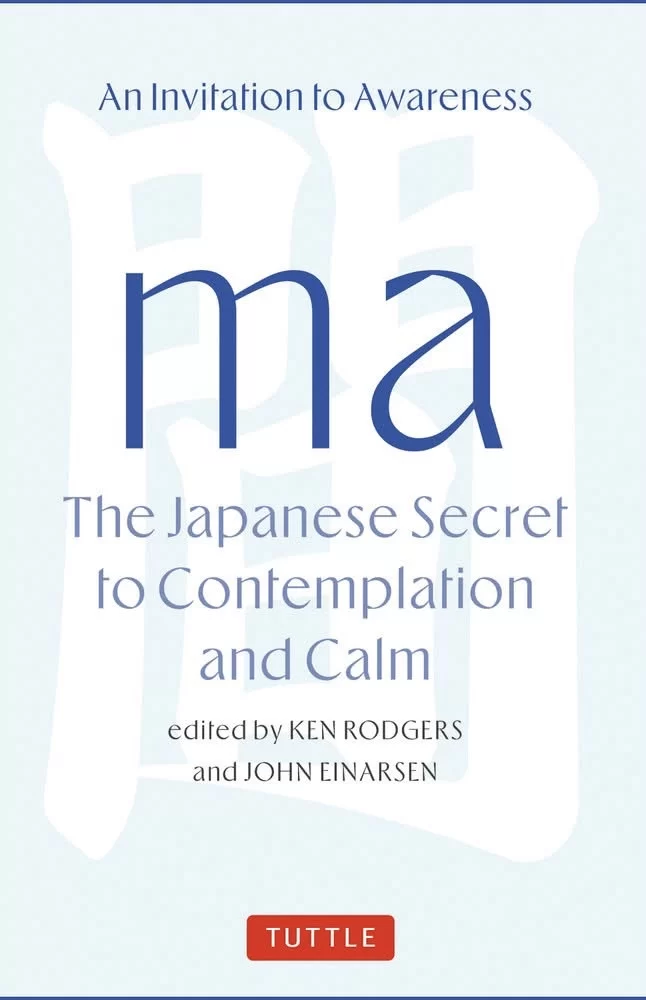
Book Review — Ma: The Japanese Secret to Contemplation and Calm
Edited by Ken Rodgers and John Einarsen (Tuttle, 2025)
This beautiful work, in hardback with a color photo spread and many black-and-white photos and drawings throughout, is dedicated to Ken Rodgers, who died suddenly last year at his home. The dedication reads:
This book is dedicated to the memory of Ken Rodgers (1952-2024),
poet, farmer, impresario, pilgrim, doting grandfather, and managing
editor of the Kyoto Journal for nearly forty years.
We all miss Ken, and are glad that this book will bear this dedication, and all our thoughts of him and his life’s work as a very knowledgeable pillar of Kyoto’s ideas and feelings, go with this volume.
The book contains eighteen stellar essays on the subject of ma — the list of contributors at the back is a compendium of contemporary writers, artists and photographers on the subjects of Kyoto and Japan. Each, in his or her own way, has thrown some light on this quality of Japanese aesthetics — some academically, others artistically.
The collection opens with an Introduction by Alex Kerr, “What is Ma?” in which he says, “this collection is perhaps the most definitive book yet published on the subject.” He enumerates three kinds of ma, according to a play-turned-novel he is working on, inspired by his friend and late admired Japanophile, David Kidd: Primal, Artistic and Cultural Ma, and provides tongue-in-cheek descriptions of the three. It is an excellent and readable introduction to this in many ways formidable topic. I myself eagerly look forward to this novel.
The second essay, by Gunter Nitschke, “Ma — Place, Space, Void” (three translations of the word into English), gives a comprehensive view of the character ma 間 as it is used in various words, with their origins and meaning, explained as The Domain of Objectivity, the Domain of Subjectivity, and the Domain of Metaphysics, each divided into several realms.
I won’t enumerate the content and thrust of each essay here, except to say that the essays deal with the concept of ma in such disciplines as tea, martial arts, the Heart Sutra, calligraphy, gardening, photography, and more.
My own experience of ma, in the Japanese discipline I know best, the tea ceremony, is my favorite moment: the sudden cessation of sound occasioned by the pouring of a ladle of cold water into the hot water of the kama (kettle) at the end of the last part of the ceremony, that of usucha (thin tea). As a matter of fact, this part of the total chaji (tea gathering) which also includes a meal, sweets, and koicha (thick tea), could be seen as a way of rejoining the ordinary world after having one’s awareness raised above it by previous experiences in the chaji. The deep and spreading silence of the cessation of the whisper of boiling water (that sound referred to as matsukaze, “the wind in the pines” which has unobtrusively accompanied activities throughout the chaji), occasioned by the addition of cold water, serves to remind us, as we come back down to the level of regular life, that this august realm is always available through encounters with the most ordinary material things. This is the essence of ma, which encompasses both the spiritual realm and the material one. At least this is how it has always seemed to me.
Another aspect of ma dear to my own heart is the phenomenon of yoin 余韻, an aesthetic word describing the carefully timed short silence at the end of performances, be they music, dance, or drama, to name a few, after the last motion has been achieved, or the last note has died away. This is ma at its finest, in my opinion.
As you can see from these examples, for me ma is intimately connected with silence, freely given, noticed or not, which is indeed a form of space. I guess I am a silence aficionado. Ma is essentially a wordless idea. We human beings do require words in order to approach this wordlessness, however, and this review is no exception.
This book provides many different aspects of ma, and those of us who live a long time in Japan have our favorites. In the end, ma is an experience shared between oneself and the material world, which cannot be put into words, and this book is a very well-written introduction, including many visual examples, which to me are essential for developing the concept in the mind. It is indeed, as the book’s superscription says, “an invitation to awareness.”