
Aki Ono paused for a moment outside the studio door. He could hear a swirl of violins coming from the sound system, and what sounded like breaking glass. He wasn’t quite sure what Mitsuki was up to, but he’d had strict orders not to interrupt. She was in the zone, in the throes of creation, and this was not the time to bring her a cup of tea.
Instead of barging in with a mid-morning snack, he entered his office and settled at his desk in his ergonomic chair, ready to delete the hundreds of emails sent to Mitsuki by fans around the world. He would read them all, of course, and reply to a handful. And he would share anything that he thought might amuse, intrigue, or inspire her.
The fan mail was a warm-up for the more serious business — the licensing agreements, the press queries, the gallerists, and the billionaire art collectors seeking to buy her work. As Mitsuki Ono’s personal assistant, he dealt with all that.
The first twenty messages he opened that morning were from fans, expressing their awe and delight at her work. One included a selfie of herself taken with “Sparkle Pony,” which was a repurposed carousel horse that Mitsuki had covered with pink paint and glitter. “It changed my life,” the woman wrote. “After I saw it, I gave up my job as a legal secretary and trained to become a manicurist.”
Aki chuckled. Mitsuki might get a kick out of this one. He printed it out and set it aside for later.
There were a couple of marriage proposals in the day’s batch of emails as well — one from a man in Iceland, another from a woman in Brazil. Aki deleted these without replying to them, but he sent a sweet letter to a woman in hospice care who wrote that her last wish was to receive a message from her art-world idol.
He sent standard rejections to bloggers and YouTubers who wanted to interview Mitsuki on their platforms, though he couldn’t blame them for trying. After all, only the scrappy survived. For inquiries from more prestigious publications, he would check with her first. It always depended on her mood. For example, she’d said “yes” to that celebrity magazine sold at supermarket checkouts in the United States a few months ago, but a week later she’d said “no” to The New York Times. With her name or image on the cover, the issue would sell out, or elicit tens or hundreds of thousands of clicks. Her very name was clickbait.
He breezed through dozens more, until he paused upon a note with the subject “Are you my mother?” It was from a woman named Kayla Brown who lived in South Carolina. She and her twin sister had been abandoned as babies in front of a fire station in Tennessee. Whoever had left them there had tucked a garland of origami cranes in the box with them, which made them believe that their birth mother was Japanese. Aki felt a pang in his chest when he read these words. She had included a photo of herself sitting in a restaurant before an array of stemmed glassware and gold-rimmed plates. Her chestnut hair was piled on her head, a few curls falling across her forehead, but he could just make out her widow’s peak. Her eyes were large, luminous, and set off by eyeliner and shimmery brown eyeshadow. She was smiling, her full lips parted slightly revealing perfectly aligned teeth. Pretty. But she’s an American. Nevertheless, he printed out the message, photo and all.
Just before noon, the door to the studio burst open, and Mitsuki shouted out, “Aki-chan, tea, please!” By this time, he had finished going through the emails. Whatever came in during the rest of the day, he would deal with tomorrow. He minimized the screen and went to the kitchen to prepare a bowl of matcha.
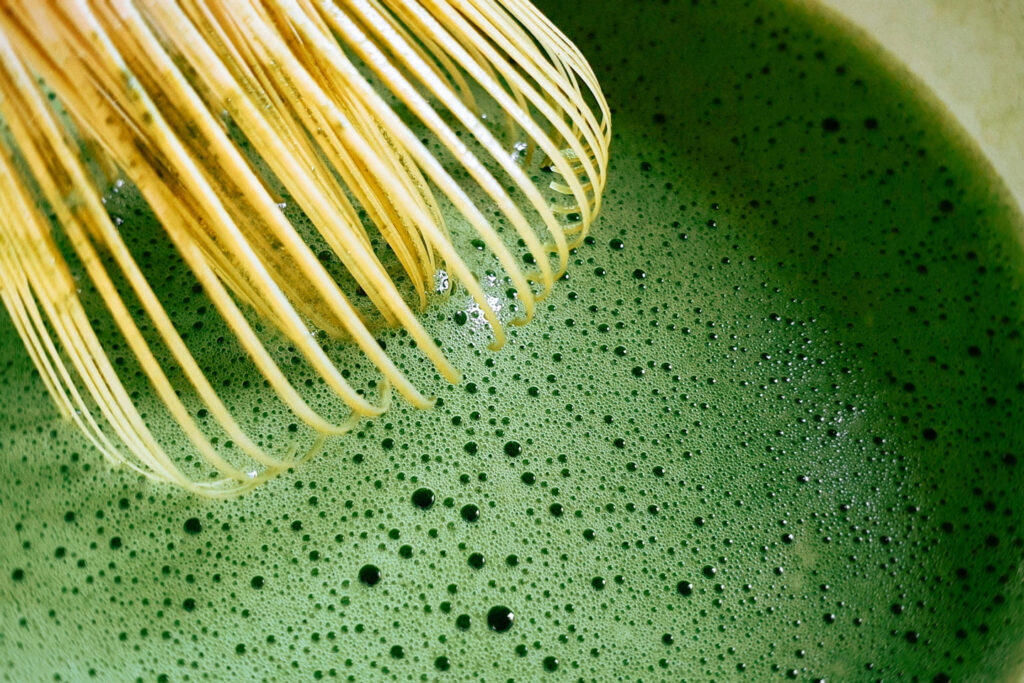
Although he been trained in tea ceremony, he didn’t bother with all the rituals for Mitsuki’s tea. Instead of sliding around on his knees on tatami, he stood at the counter and opened a cannister of powdered green tea. He used a bamboo spoon to scoop tea into a ceramic bowl, added hot water from an electric dispenser on the counter, and whisked the tea with deft motions of his wrist. He put the bowl of tea on a lacquer tray along with a sweet made of mochi and mashed, sweetened adzuki beans settled on a small plate. Then he carried the tray to the living room where Mitsuki was sitting regally on an embroidered cushion at a low table, taking a break.
“Here you are, Mother,” he said.
She smiled, her whole face lighting up. “Thank you, Aki-kun.”
She bowed slightly, lifted the bowl, and settled it on the palm of her left hand. With her right hand cupped around the side of the bowl, she turned it three times toward her before slurping it down.
“Ahh. That hit the spot,” she said, stabbing the beancake with a tiny wooden knife.
Aki waited until she had swallowed the last tiny bite before presenting her with the messages that he had printed out. He’d also made copies for himself, in case she didn’t feel like reading them.
“Shall I begin?” he asked.
Mitsuki nodded. She made no motion to lift the pages, closing her eyes instead. It helped her to concentrate.
He went through the various invitations and media requests.
“Art in America?”
“No.”
“Brazilian Vogue?”
“Yes.”
“The Japan Times?”
“No.”
Aki sorted the messages into two piles. Next, he read the letter from Kayla Brown. Sometimes, bored by the ramblings of strangers, she would cut him off. But this time, she listened to the end. When he got to the part about the fire station in Tennessee, he thought he heard her gasp. Halfway through, her eyes opened, and she gazed intently at the wall. Aki glanced over, expecting to see something there — maybe a spider, or a shadow. Or a ghost. By the time he reached the end of the message, her lower lip was quivering. She pressed her hands on the table in front of her as if she were bracing herself against something.
He paused for a moment after reading, “Regards, Kayla Brown.” Somehow bringing this to her attention suddenly felt like a terrible mistake.
“Invite her to come visit,” Mitsuki said in a steely voice, still staring at the wall.
“Pardon me?” There was no way that this woman and her sister could be her daughters. Or could they be? He looked over at the portrait of Mitsuki and Joseph Heinz, one of only two photos that she displayed on the credenza —the other was of her as a child with her enormous family — and tried to discern a resemblance between them and the woman. Yes, both this woman, Kayla, and Mitsuki had a similar hairline, a widow’s peak, and her nose was sort of tall and hooked like his. Joseph had been the love of her life, her only love. And they had never had children. Or at least that’s what Mitsuki had always told him. Had she been lying?
Now, Mitsuki looked straight at her son and said, “Book a ticket for her as soon as she can come. We will welcome her.”
Aki tried to remain stoic. Sure, she had enough money to fly some stranger over at a whim, but this Kayla person might be some sort of con artist. Maybe she was trying to get access to Mitsuki for a book or an article or some ridiculous podcast. He couldn’t imagine welcoming this random American woman into their midst. Did Mitsuki intend for her to stay with them under the same roof? Finally, he took a deep breath, and let it out in a long stream before replying. “Shall I tell her that you are her mother?”
“No.” Mitsuki laughed. “Tell her that I would like to offer her a job.”
Aki could only nod. He had no idea what kind of job she had in mind for this person, but he knew that his own job was secure. He also knew from experience that she would never change her mind.
Now that their business was out of the way, Mitsuki softened, morphing into her maternal role. “Do you have any plans for this afternoon?” she asked.
Aki nodded. “I’ll be going to visit Kono-san in the nursing home.”
“You’re a good boy,” she said, reaching over to pat his shoulder.
He accepted her praise, but they both knew that his sitting by the old woman’s bedside, listening to her ramble about the past, wasn’t entirely altruistic. He was being paid by the woman’s son, who was working for a bank in London, to visit his mother and pretend to be him. He had met the man via video and mastered a few of his quirks and stock expressions. His mother, Kono-san, who was in the latter stages of dementia, seemed to accept that Aki was her son. Or at least she pretended that she did.
Aki had other acting jobs as well. Although when asked, he said that his job was working as Mitsuki’s assistant, he considered acting his real job. He had actually appeared in a film, one made on the streets of Kyoto by She, Whom He’d Rather Forget. He even had an IMBD page as evidence of his participation. He rarely mentioned that, though. And most of his work involved showing up at real life events and participating in someone else’s deception. He’d been a mourner at a funeral more than once, sort of like those hired wailers in the Middle East. He’d escorted women who’d lied about having boyfriends to family gatherings. And he’d once pretended to be a little girl’s father at a PTA meeting. Sometimes he would become so engrossed in his role that he would forget that he was Aki Ono, lonely boy. Strangers would hug him and clap him on the back. They’d fill his cup with beer or sake, and hand him gifts as he made his exit. He would begin to believe that he was surrounded by dozens of family members and friends who truly cared about him, that his life was, and always had been, overflowing with love. Maybe someday he really would find someone who was related to him, who would say, “I’ve been looking for you all of my life.”