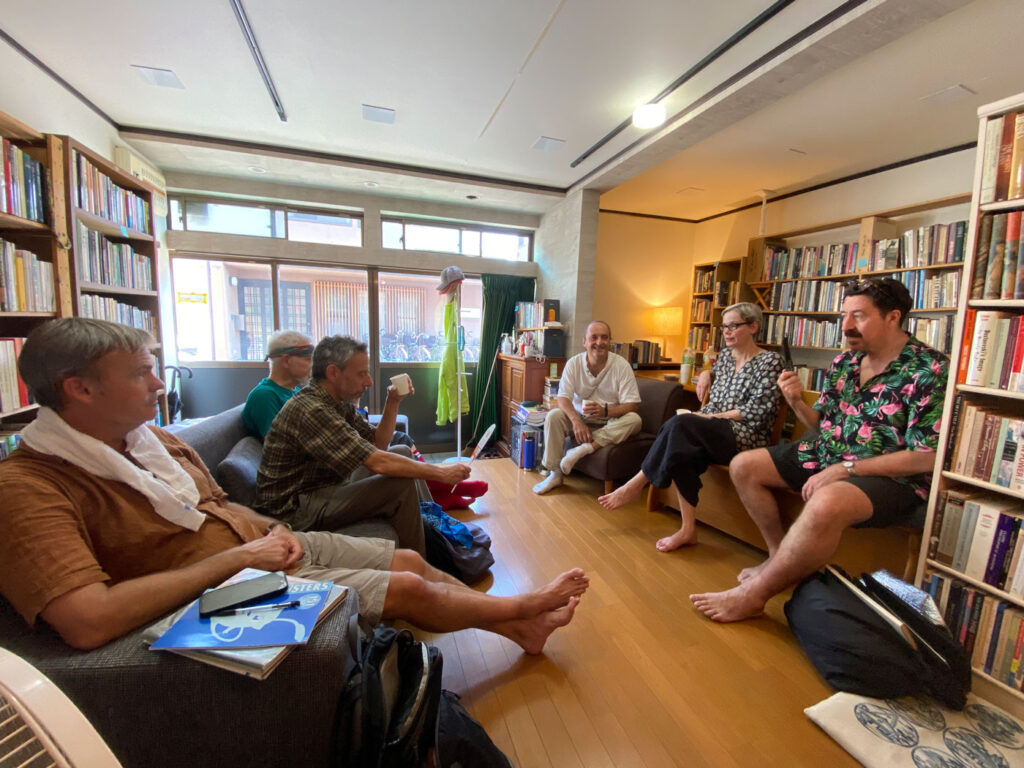
When the Wuhan virus came to squat, the posture stuck. Go out? Why bother? And in this heat. Nevertheless, one of eight people, I found myself comfortably perspiring in David Duff’s book-walled room. Able facilitator Andy Couturier was starting to gently manage the afternoon.
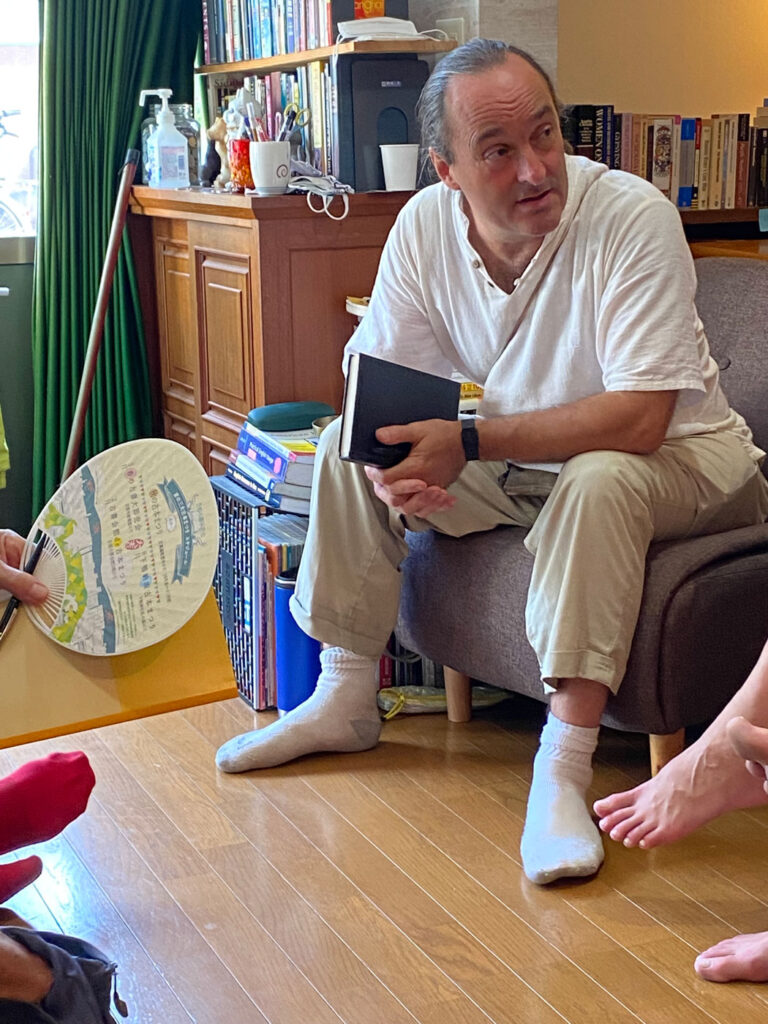
“Ting….. . . . . . .”
His singing bowl rang but not everyone was ready to hear it. When the talk lulled:
“Ting….. . . . . . .” again.
Focus. Cautioning us against negative thoughts, hoping for comments based on ‘appreciative inquiry’, he encouraged us to make eye contact with each person in the room. This was repeated later.
Now we were receptive, after showing pictures of Classically Balanced Imposing State Buildings (my styling, my impression) in Washington DC, a city he could not warm to as a child, he downplayed the forms of connected rational, one-thing-leading-to-another composition structures that our educators inculcated into our minds. On the fringes of states, communities with different narrative traditions survive. Children here find it hard to sew text with classical threads.
Likewise, translators from Japanese into northern European or Romance languages, have problems making comprehensible, to target readers, newspaper op-ed content written in ki > shō > ten > ketsu form.
Presenting asymmetry, Andy showed pictures of ikebana, ink drawings, a gable wall with higgledy-piggledy — sorry, “asymmetric” — windows in his house. The important thing in such arrangements is the space between elements and clustering…
Space             mind      play
         where            can
Japanese art, they say, does not impose something finished on the observer, reader, or listener: during its reception, a response emerges, a process towards perfection. Andy likes the concept of emergence. And what’s not to like?
Now we were clued into asymmetry and space, the writing could begin.
Lists. Things you want and don’t want to write about. Today’s Categories: Faces, Scenes, Ideas, Feelings. Under those, any Items that come out of your pen.
Prompted by our items, we wrote for thirty-five minutes.
While the first volunteer read a long and fluent passage, Andy took notes. Afterwards, he shared a list of seemingly random words culled from the text. The effect was poetic and impressive. From a comment Andy made, such lists may hint at the interpretation that a receiver of communication makes during reception.
From my dump of disparate items, I read a personal, chronological passage that jumped locations. When I read it aloud, it had story. Andy read back his word list:
“Tch! He didn’t get it”—at-the-same-time—“Ah, openness, and textual non-completion.” He had engineered showing not telling. Reception. I was learning.
Hanging out with differently like-minded people, writing along with others, hearing feedback on their writing and my own… a rewarding afternoon. I’m glad I bothered.
Andy Couterier’s website, theopening.org has relevant articles:
His book, Writing Open the Mind, is available on Amazon and elsewhere.
On YouTube, Andy has posted a Zoom session of the same type of workshop.